eFoil for Beginners: The Features That Actually Matter

eFoil for Beginners: The Features That Actually Matter
Anyone who steps onto an eFoil for the first time quickly realises that technical setup plays a decisive role in both learning progress and safety – right alongside rider skill. There are significant differences between models on the market when it comes to stability, drive system, and lift behaviour. Not every eFoil is equally well suited to beginners.
This article breaks down the technical features a beginner eFoil should have – with concrete criteria you can apply when comparing models. No buying recommendations, just technical clarity.
Board Volume: More Litres Mean More Stability
A board with more than 100 litres of volume offers noticeably better lateral stability on the water than more compact alternatives. Volume indicates how much water the board displaces – and therefore how much weight it can support before sinking.

As a rule of thumb: board volume should be at least 20 to 40 litres above your own body weight. At 80 kg, that means a board with at least 100 to 120 litres. This kind of setup forgives weight shifts and gives the rider more time to react when getting up.
Longer boards reinforce this effect further: a wider standing area is less sensitive to small balance errors. For the first sessions – progressing from lying down to kneeling to standing – that translates into a concrete advantage: fewer falls.
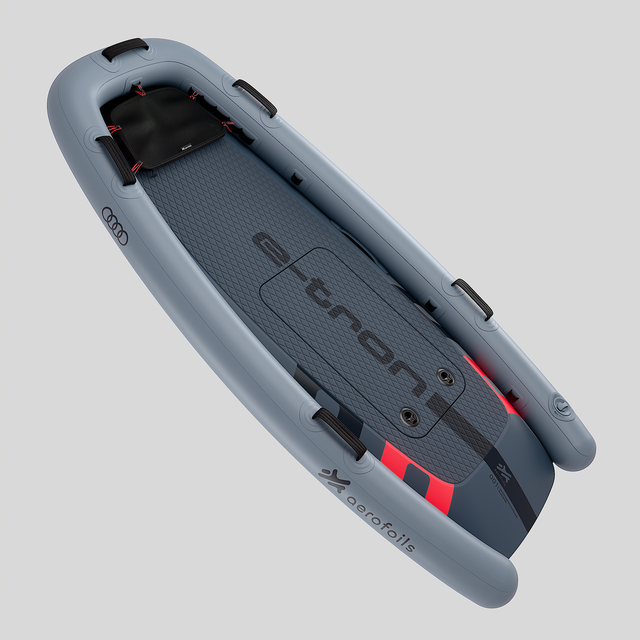
Practical tip: Boards under 80 litres are designed for experienced riders. As a beginner, volume should generally not drop below 100 litres – regardless of the model. The Adventure set from Aerofoils comes with 103 litres – the highest volume in the entire product range.
The Wing Determines Your Lift
A large front wing with a surface area of around 1,500 cm² generates lift even at low speeds. In practice, this means the eFoil board rises out of the water earlier, and the rider needs to build less speed before lift-off becomes controllable.
Smaller wings respond more precisely – but they are far less forgiving. Jerky throttle inputs, one of the most common causes of falls when efoiling, are absorbed much more effectively by a large wing. It forgives where a small wing punishes.
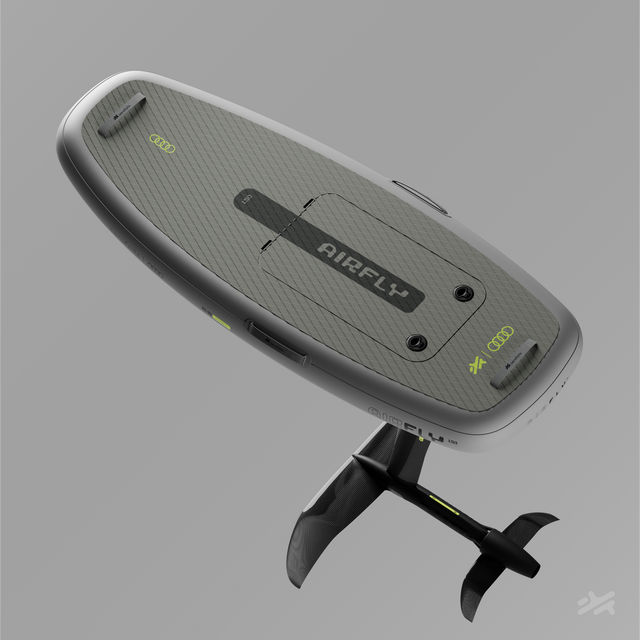
The right wing choice also determines how much flexibility you have during the learning process. Starting with a large wing means you can switch to a smaller, more agile option later – without having to replace the entire system. With Aerofoils, different front wings within the same model system are interchangeable: someone starting out on the Freeride wing, for example, can later switch to a smaller Freerace wing. The available wings are sold separately. Mast length also influences ride behaviour – more on that in the next section.
Mast Length: Shorter Masts for Beginners
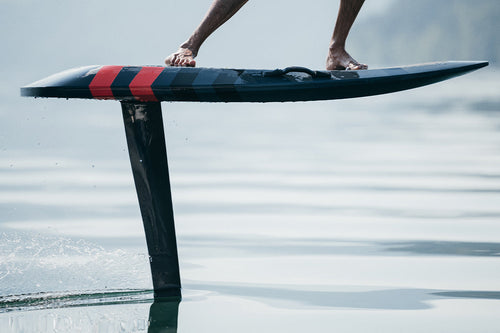
The mast connects the board to the underwater components of the eFoil – it determines flight height above the water. For beginners, a mast length under 65 cm has proven to be the right choice: it keeps the board closer to the surface and generally makes height control easier.

A longer mast allows for greater flight height and more room to work with in waves – but it is significantly harder to manage for beginners. A fall from greater height also means a harder impact. For early sessions on a lake, that is a risk worth avoiding.
The key parameter for beginners is length – under 65 cm, regardless of material. Carbon masts respond more precisely than aluminium and are more forgiving of weight shifts than their reputation might suggest. Starting on carbon means you are already riding the same material you would use at an advanced level later on.
Drive System: Jet Drive vs. Propeller
The drive system is a central safety criterion for any eFoil – particularly for beginners. Most models on the market use an exposed propeller mounted on the outside of the mast. In the event of a fall close to a running motor, the rotating parts present a real injury risk.
A fully integrated jet drive works differently: water is drawn in, channelled through a closed system inside the hull, and expelled at the rear. There are no exposed rotating parts. The injury risk from the motor is thereby almost entirely eliminated.
Aerofoils brings years of aerospace engineering expertise to its design – the jet drive is not a compromise, but a deliberate engineering decision. The drive is fully integrated into the hull, with no exposed rotating parts in the water zone. For beginners who fall more frequently in the first sessions than experienced riders, that represents a meaningful safety advantage.
Key takeaway: when comparing options on the market, drive type should be among the first criteria you evaluate – before volume and performance.
eFoil Scooter: The Easiest Entry into Efoiling
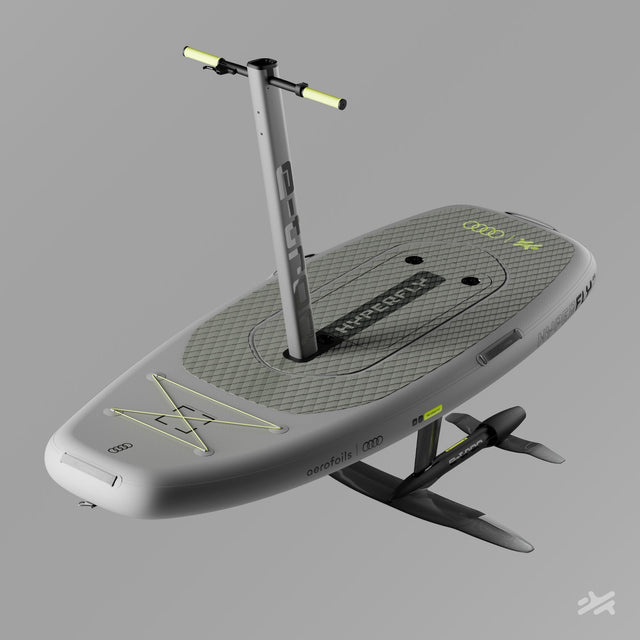
An eFoil scooter with a fixed handlebar fundamentally changes the riding feel and the balance challenge. Instead of maintaining balance purely through weight shifts, the handlebar gives the beginner a fixed point to hold onto. The sensation of flying above the water comes within the first few minutes – without the frustration of a long learning curve.
The Hyperfly from Aerofoils offers 230 litres of volume and a removable handlebar. The high lateral stability makes it the right equipment for beginners with little prior watersports experience. Once the first manoeuvres feel solid, the handlebar can be removed – making the transition to a classic eFoil seamless. That is freedom with a system: you decide when you are ready.
For schools, resorts, and rental operations, the eFoil scooter noticeably reduces supervision requirements: different body sizes and experience levels can all work with it equally well.
Protective Gear: Nothing to Do With Skill Level
Helmet and impact vest should be worn during every session – from the very first ride, regardless of the body of water. The most common cause of falls is jerky throttle input: the board responds immediately to the power surge, and anyone who is not prepared goes into the water.
The basic rule for falling: jump backwards or to the side of the board – never forward in the direction of travel. A wetsuit provides additional protection against cold water and abrasions. Even in warm conditions, it reduces skin friction during fast water contact.
When comparing efoiling models, it is worth looking at the safety setup: most systems automatically cut the motor when contact with the remote control is lost. For beginners, this feature is not optional – it is a basic safety requirement.
eFoil Lesson: Two Hours That Make All the Difference
Most beginners achieve their first stable flight experience after one to two hours of professional instruction. A structured beginner course at an eFoil school saves time, protects the equipment, and minimises accident risk from poor technique – more effectively than any amount of self-research.
An introductory course typically lasts two hours, with 90 minutes on the water. Learning progresses through three phases: lying down, then kneeling, then standing. Knowing this sequence and understanding the process helps you move through it faster. The minimum age varies by provider and location, but is often 16 – in certain cases, courses for young riders from age 12 are possible. Exact rules vary.
eFoils with standard power output are classified in Germany as licence-free small watercraft – no boating licence is required. Individual bodies of water may have their own usage rules that should be checked before your first ride. Rental and course providers typically require a valid ID and proof of personal liability insurance.
The Right eFoil for Beginners: Technology That Holds You Up
A beginner eFoil stands or falls on four parameters: sufficient volume, a large wing, a short mast – and a drive system with no exposed rotating parts in the water zone. Apply these criteria when comparing models and you will narrow the market down to a fraction of what is available.
The rest is experience. A professional course accelerates the learning curve more than any equipment upgrade ever could. Combine the two – the right board and two hours of guided riding – and most beginners are standing stably above the water sooner than they expect.
Frequently Asked Questions About Getting Started with eFoiling
How quickly can a beginner learn to eFoil?
Most beginners are standing stably on the board after one to two hours of professional instruction. The learning progression runs through three phases: finding balance while lying down, then kneeling, then standing. Those who start without a lesson typically need several more sessions to reach the same point – and tend to make more mistakes along the way that cost both equipment and motivation.
What board volume do I need as an eFoil beginner?
Board volume should be at least 20 to 40 litres above your own body weight. At 80 kg, a board from 100 litres upwards is the right choice. More volume means more buoyancy, more lateral stability, and fewer falls in the first sessions – boards under 80 litres are designed for experienced riders.
Is a jet drive really safer than a propeller?
Yes – a fully integrated jet drive almost entirely eliminates the injury risk posed by exposed drive components. With a propeller system, falling close to a running motor creates a real risk of contact with the rotating parts. For beginners who fall more often in the first sessions than experienced riders, this difference is a genuine safety consideration – not just a technical detail.
Do I need a boating licence to ride an eFoil in Germany?
No – eFoils are classified in Germany as licence-free small watercraft, and no boating licence is required. Individual bodies of water may have their own usage rules that should be checked in advance. Rental and course providers typically require a valid ID and proof of personal liability insurance.
What protective gear do I need for eFoiling?
Helmet and impact vest are essential – regardless of experience level. A wetsuit is also strongly recommended for protection against cold water and abrasions. Most course providers supply equipment during the beginner lesson. Anyone purchasing their own eFoil should factor in protective gear from the outset.