Aerofoils Fully Shielded Propeller (Jet) vs. Open Propeller: What Really Makes the Difference on an eFoil

You step onto the board, accelerate, and suddenly you're no longer on the water – you're above it. Silent. Weightless. That's the exact moment you realise why the drive system isn't just a detail – it's the heart of the entire experience. Because how you fly depends fundamentally on what's happening beneath the surface.
Aerofoils has taken a clear position on propulsion: no open propeller, no compromises on safety, no unnecessary drag. The result is the world's first Fully Shielded Propeller – also referred to as a jet drive – a fully enclosed, deeply integrated propulsion system. This comparison shows what that means against a conventional open propeller setup.
The Fundamental Problem with Open Propellers
A conventional open propeller works on a simple principle: rotating blades push water backwards to generate thrust. It's effective – but it comes with a set of drawbacks that carry particular weight in the eFoil context.
Safety: The open propeller spins at high RPM directly beneath the board. When a rider falls, they enter the water in close proximity to the drive unit. Propeller injuries are a well-documented category in watersport accident statistics – and on an eFoil, this risk is structurally built in as long as rotating parts remain exposed.
Drag: An externally mounted propeller with a larger diameter creates hydrodynamic drag – even when it's not running at full load. That costs efficiency and, ultimately, range. The Aerofoils impeller, by contrast, is fully integrated into the lower end of the mast, making it far superior to bolt-on variants in this regard.
Noise and vibration: Open propellers operate in a less controlled flow environment, which generates noise and vibrations that directly affect the riding experience.
Vulnerability: An exposed propeller is exposed by definition. Contact with a rock, a branch or seaweed can damage the blades or jam the drive entirely – a very real scenario in shallower waters.
The Aerofoils Approach: Fully Shielded Propeller – or Simply: the Jet
Aerofoils didn't respond to these structural weaknesses with workarounds. Instead, the entire drive system was redesigned from the ground up.

The Fully Shielded Propeller – often simply called the jet – is fully integrated into the mast. There are no exposed rotating parts, no openings, no gap through which a finger or algae could find their way.
The result can be summarised in three points:
- 100% safety: No exposed propeller. No rotating surface that can become a hazard in a fall. This level of protection isn't incrementally better than an open drive – it's a different category entirely.
- Minimal drag: The fully integrated, slim jet drive generates significantly less hydrodynamic drag than an externally mounted propeller with a larger diameter. This translates directly into greater efficiency and higher top speed.
- Exceptionally quiet: Because the drive is completely enclosed, the Fully Shielded Propeller – the jet – runs far more quietly and with far less vibration. The sensation of flying remains completely undisturbed.
Direct Comparison: Fully Shielded Propeller (Jet) vs. Open Propeller
| Criterion | Fully Shielded Propeller / Jet (Aerofoils) | Open Propeller |
|---|---|---|
| Safety | 100% – no exposed parts | Rotating blades freely accessible |
| Noise | Extremely quiet, no vibration | Audible, stronger vibration |
| Top speed | Up to 55 km/h | Varies by system |
| Damage risk | Fully protected | Propeller blades vulnerable to contact damage |
| Maintenance | Less exposure, less wear from external contact | Propeller replacement required if damaged |
What This Means for Your Riding Experience
The technical advantages of the Fully Shielded Propeller – the jet – are measurable. But above all, they make themselves felt while riding, and on several levels.

On takeoff, the integrated jet drive builds thrust precisely and predictably. Torque is available immediately, and lift develops smoothly and in a controlled manner – an advantage that matters most during the learning phase. Riders who follow a structured path through the Aerofoils Academy benefit from the fact that the drive system and the teaching programme are perfectly aligned.
While cruising, the smoothness of the drive becomes unmistakable. No vibration, no hum – just the quiet sensation of gliding across the water. For the feeling of flight that eFoil riders describe, low noise isn't a luxury; it's a core part of the experience.
At top speed, the jet proves its advantage through minimised drag. Speeds of up to 55 km/h are achievable – without a larger, exposed propeller compromising the hydrodynamics.
Which Aerofoils Board Is Right for You?
The Fully Shielded Propeller – the jet – is built into every board in the Aerofoils range. What differs is the volume, the intended use and the feel on the water.
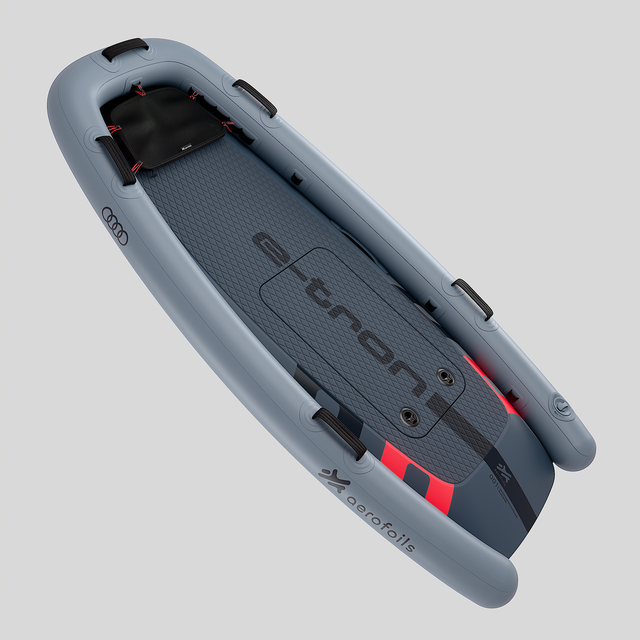
Anyone looking for a stable, confidence-inspiring entry point will find exactly that in the Adventure (103 litres) – the line's bestseller, compatible with the inflatable Aeroloop. Riders who are already confident and want more agility will find their match in the Performance (83 litres). For competition riding – or for anyone who wants to push uncompromisingly towards top speed – the Competition in full carbon is the answer.
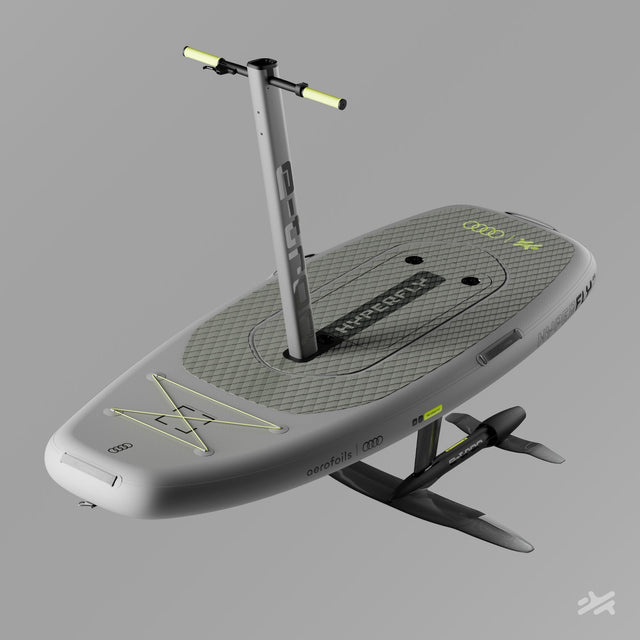
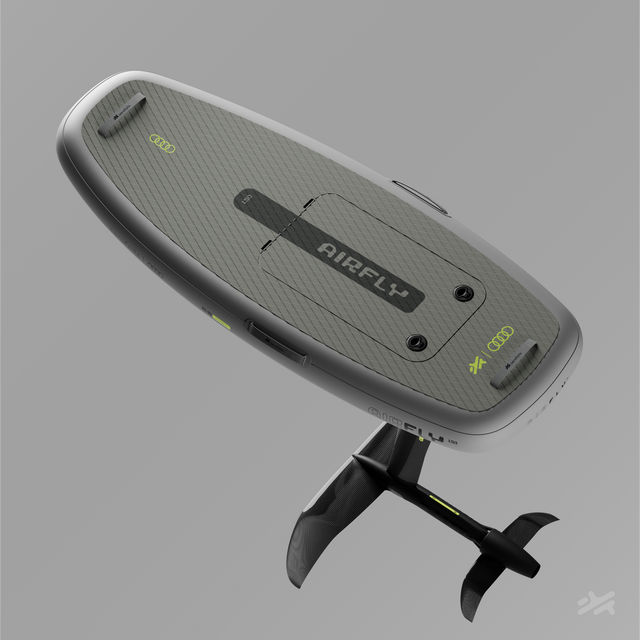
Travellers can choose between the Airfly (150 litres, inflatable) and the Hyperfly (230 litres, inflatable, with removable Hyperbar handlebar – rides like a scooter). Both bring the jet drive wherever the journey takes you.
How long you ride is up to you and your battery choice: the Light battery (8.8 kg, approx. 60 minutes) for intensive sessions, or the Endurance battery for up to 2 hours on the water.
Conclusion: Not a Compromise – a Different Standard
An open propeller isn't an outdated concept – but it carries structural limitations that simply don't have to be accepted in the eFoil context. With the Fully Shielded Propeller – the jet – Aerofoils has demonstrated that safety, efficiency and performance aren't competing priorities. They're the result of one uncompromising design decision.
The smallest propeller diameter on the market. Complete enclosure without exception. Top speeds up to 55 km/h. And a riding experience that puts nothing between you and the feeling of flight.
Your Next Step
Find the board that fits you – and discover what a thoroughly engineered jet drive feels like on the water:
- Adventure – 103 L, bestseller, stable & versatile
- Performance – 83 L, agile & sporty
- Competition – 73 L, full carbon, for advanced riders
- Airfly – 150 L, inflatable, perfect for travel
- Hyperfly – 230 L, inflatable, rides like a scooter
- Batteries – Light (60 min) or Endurance (up to 2 hours)
- Accessories – Everything for your setup
- Academy – Structured learning programme for beginners