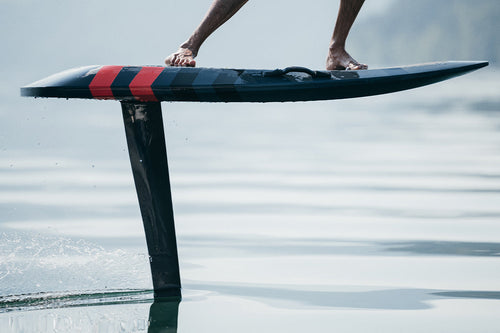
eFoil Altitude Control – Techniques & Tips for Stable Flight

eFoil Altitude Control – How to Fly Safely and with Precision
Maintaining altitude on an eFoil isn't about feel – it's about technique. Many beginners struggle in their first sessions because the foilboard either stays too low or rises too sharply and crashes back into the water. Both problems share the same root cause: uncontrolled weight shifting and poorly managed throttle.
Understanding how lift, body position and drive work together makes you a more stable rider – and accelerates your progress. The experience of gliding smoothly and in control above the water starts right here: with a solid grasp of the physics involved. This practical guide walks you through the essential techniques step by step – for every eFoiler who wants to control their altitude safely and with precision.
Why Altitude Control Is Physics, Not Feel
Throttle doesn't control height – weight distribution does. The front wing works just like an aircraft wing in water: it generates lift through the pressure difference above and below the underwater foil. The faster the board travels, the more lift is produced – and the higher the board rises out of the water.

Throttle via the hand remote controls speed, and therefore indirectly controls lift. Altitude itself is actively steered by the rider through body position. Once you understand this, you stop instinctively reaching for more throttle when the board drops – and start responding with your body instead.
In short:
Throttle controls speed. Your body weight controls altitude. That separation is the key to stable, confident riding.
The Front Foot Is the Primary Control – How to Use Weight Shifting Effectively
Your front leg is the primary control for altitude. Shifting weight forward reduces the foil's angle of attack and brings the board closer to the water surface. Shifting weight backward increases the angle of attack – and the board rises.
The angle of attack changes with even the smallest movement of your hips or upper body. In the first few sessions, riders often overcorrect, leading to uncontrolled altitude swings. Experienced riders work with minimal, precise weight shifts – barely perceptible to an outside observer.
The correct base stance: knees slightly bent, upper body upright, weight evenly distributed. From this balance point, you initiate every altitude correction – small, controlled and deliberate. Developing this skill also teaches you the limits of the board – and how safely you can explore them.
Why this matters:
Trying to control altitude through your upper body means you're always reacting too late. Control starts at the front knee – that's where every correction needs to begin.
Throttle Discipline – The Most Common Beginner Mistake
More throttle means more speed – and more lift. When the board climbs too steeply due to excess power, the front wing eventually loses contact with the water mass: the board breaches and falls back into the water. This moment is known as a breach.

The most common cause of a breach isn't a lack of skill – it's abrupt throttle input. Smooth, consistent throttle management is therefore essential. Build speed, stabilize your altitude, then hold steady – don't keep accelerating. The electric motor delivers power immediately and directly – unlike an internal combustion engine, there's no lag. That makes precise throttle control more critical, but also more learnable.
The Aerofoils Speed Limiter helps dampen sudden acceleration inputs and keeps control within the right speed range. Especially during the learning phase, this builds confidence – while also protecting the battery by avoiding unnecessary full-throttle bursts.
Finding the Balance Point – Stable Flight Angle in Practice
The balance point is where the board flies level and neither rises nor drops. Riders who actively find and hold this point fly smoothly. Those who chase it reactively constantly battle altitude swings.
Here's how to find it: once the board has lifted off, hold speed steady and gradually shift weight forward – until the board stops climbing. That point is your neutral flight position. From here, you learn to make minimal corrections and return to neutral.
An active stance with slightly bent knees helps absorb chop or minor surface irregularities. The board responds softly, not abruptly. Locking your knees removes that buffer and puts you in a fight against the board rather than in sync with it.
Why the Drive System Affects Altitude Stability
Not every eFoil behaves the same way during take-off. A critical factor is how consistently thrust is built up. Propeller-based systems can produce thrust fluctuations in certain RPM ranges that destabilize the board during the critical take-off phase.
The fully integrated jet drive from Aerofoils delivers direct, smooth thrust without any exposed rotating parts. The result: a controlled, linear transition from the water surface into flight – with no sudden impulses that throw the rider off balance.
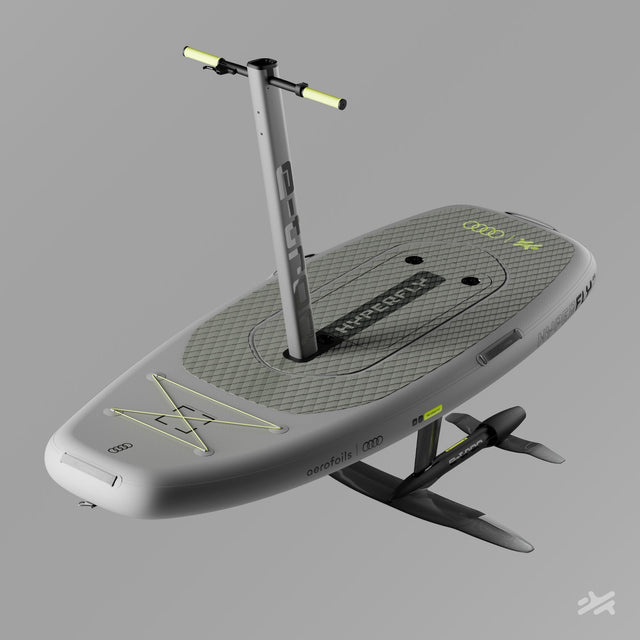
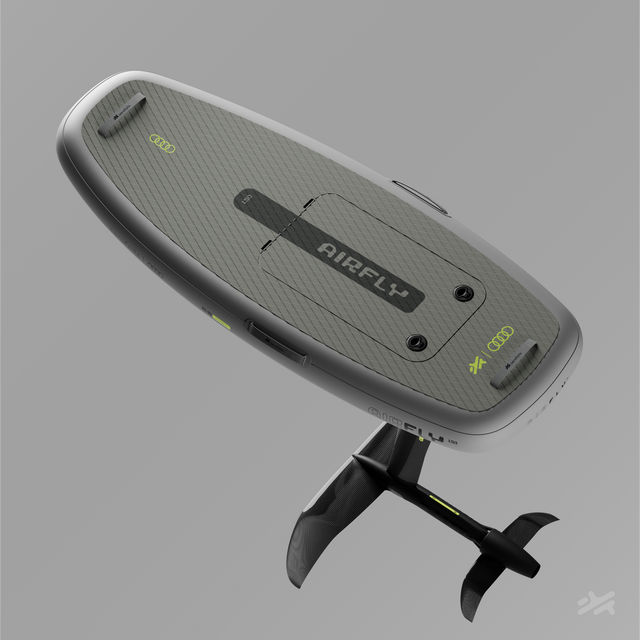
The Aerofoils Anti-Breach System (ABS) adds another layer of control at a physical level. It uses deliberately engineered air turbulence to passively limit uncontrolled upward movement beyond the safe flight envelope. No active intervention, no sensors – just engineering built directly into the geometry of the system. This significantly reduces the risk of injury from uncontrolled breaches – particularly in the first sessions, when abrupt altitude changes are the most common cause of falls. The ABS comes standard in the Hyperfly and the Airfly.
Key takeaway:
Stable altitude starts with a controlled drive system. The propulsion concept plays a direct role in how quickly a rider achieves real control.
Board Setup: Choosing the Right Mast Length and Wing Size
Your setup determines how easy or difficult it is to maintain stable altitude. Larger front wings generate more inherent stability and are more forgiving of weight-shifting errors. For beginners, they're clearly the better choice – while advanced riders tend to prefer smaller, more responsive wings for greater dynamics.
A longer mast allows you to fly higher above the waves – but demands more precise steering, as every weight shift has a more pronounced effect. For the first few sessions, a shorter mast makes more sense: it keeps the board in a manageable altitude range close to the water surface.
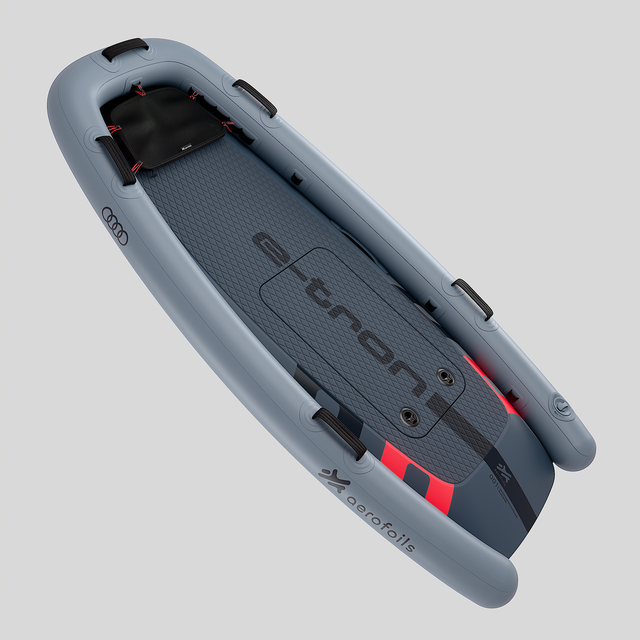
Aerofoils offers a range of configurations for different skill levels. The Adventure set, with its 103-litre volume and larger front wing, is specifically designed for maximum inherent stability – ideal for your first hours on the water. The Performance set offers greater maneuverability for riders making the step into intermediate and advanced territory.
Training Altitude Control – A Step-by-Step Approach
You won't master altitude control in a single session. But with the right training progression, improvement comes quickly – and the enjoyment grows with every controlled minute in the air.
Phase 1 – Controlled take-off: Build speed lying on the board, then carefully stand up. The goal: let the board lift off in a controlled way and immediately bring it back down. No extended flight phases – just repeat the take-off.
Phase 2 – Finding the balance point: Once take-off is reliable, hold speed steady and actively search for the balance point. Weight forward – board descends. Weight back – board rises. Internalize this relationship through your body.
Phase 3 – Refining corrections: Make your corrections smaller. Less body movement, more precision. Practice slalom lines and deliberately engage the board's rails – this builds the muscle memory for simultaneous altitude and direction control. Once that feeling becomes second nature, new skills open up one by one: clean carves, higher flight altitude, first tricks and eventually controlled jumps.
Calm conditions and flat water are most effective for all three phases. Learning in challenging conditions slows progress – it doesn't accelerate it.
Altitude Control Is a Learnable Skill – With the Right Technique
Stable altitude is the result of three things: body control, throttle discipline and the right setup for your level. Understand and train these three factors, and you'll make clear, measurable progress in a short time – whether you're still in your first sessions or already riding regularly.
Both the Adventure Set and the Performance Set are designed to make this learning process as direct and as safe as possible – with a drive system that enables precise control from day one.
Frequently Asked Questions About eFoil Altitude
How do I maintain stable altitude on an eFoil?
Altitude on an eFoil is controlled through active weight shifting – not by adding throttle. The front leg lowers altitude; the back leg raises it. Smooth throttle input and a slightly bent knee position in your base stance help keep altitude consistent.
Why do I keep losing altitude or climbing too steeply?
Altitude loss is usually caused by insufficient speed or too much weight on the front foot. Uncontrolled climbing – up to and including a breach – is caused by too much throttle or rearward weight shift without correction. Both mistakes can be avoided by staying aware of the balance point and making calm, measured corrections.
What is the balance point in eFoiling?
The balance point is the body position at which the board flies level – neither climbing nor descending. It sits at evenly distributed weight, upright posture and slightly bent knees. All altitude corrections are initiated from this point.
Which eFoil board is best suited for stable altitude?
Boards with greater volume and a wider front wing are more stable and more forgiving of weight-shifting errors. For beginners, a high-volume board with a shorter mast is the safest choice – it keeps altitude in a manageable range close to the water surface.
What is the Anti-Breach System and how does it help with altitude control?
The Anti-Breach System (ABS) is a solution built directly into the board's geometry that passively limits uncontrolled upward movement beyond the safe flight envelope. It generates targeted air turbulence that keeps the board within a stable flight range – without active sensors or electronic intervention.
At what speed does an eFoil take off?
Most eFoils lift off at around 12–20 km/h, depending on rider weight, wing size and mast length. At that point, the front wing generates enough lift to raise the board out of the water. Too much throttle at that moment leads to a rapid and uncontrolled climb.